
At a Glance Multi Plant Operational Telemetry and Anomaly Detection
A global specialty chemicals manufacturer operating 14 continuous processing plants with over 80,000 IoT sensors tracking temperature, flow rate, pressure, and chemical acidity.
Run on Yantra · Industrial Operations Console

Plant operators monitored 25 separate SCADA and historian screens per control room, creating cognitive overload during critical process shifts.
Unified Multi Plant Sensor Stream Ingestion → Single Pane Operational Cockpit → Automated Statistical Anomaly Detection → Color Coded Risk Heatmaps
Unplanned reactor process shutdowns reduced by 72%, saving $3.2M annually.
The challenge
Plant operators monitored 25 separate SCADA and historian screens per control room, creating cognitive overload during critical process shifts.
Subtle process drift, such as minor heat exchanger fouling, went unnoticed across shifts until reactors exceeded critical thermal trip thresholds.
Unplanned reactor emergency shutdowns cost over $450,000 per incident in discarded raw materials and line decontamination downtime.
How our team solved it, with Yantra
- 01
Unified Multi Plant Sensor Stream Ingestion
Yantra aggregates real time telemetry from OPC UA, MQTT, and legacy SCADA systems across all 14 manufacturing facilities.
- 02
Single Pane Operational Cockpit
Yantra renders a high level plant overview displaying live process health status, vessel conditions, and throughput rates.
- 03
Automated Statistical Anomaly Detection
Yantra detects subtle multivariate sensor drift, such as pressure drop across catalyst beds, 18 hours before operating limits are breached.
- 04
Color Coded Risk Heatmaps
Degrading plant zones are highlighted on interactive 2D and 3D plant floor layouts, guiding operator attention immediately.
- 05
Predictive Maintenance Ticket Drafting
Yantra drafts maintenance work requests with the exact sensor telemetry attached when process deviations occur.
- 06
Maintenance Planner Approval
The plant maintenance planner reviews each drafted request and approves it before it is dispatched to technicians.
The outcome
- Plant operators monitored 25 separate SCADA and historian screens per control room, creating cognitive overload during critical process shifts.
- Subtle process drift, such as minor heat exchanger fouling, went unnoticed across shifts until reactors exceeded critical thermal trip thresholds.
- Unplanned reactor emergency shutdowns cost over $450,000 per incident in discarded raw materials and line decontamination downtime.
- Unplanned reactor process shutdowns reduced by 72%, saving $3.2M annually.
- Control room operator alarm fatigue reduced by 60% through single pane visual telemetry.
- Early detection of process drift improved from 15 minutes to 18 hours prior to threshold breaches.
Delivered for a client; the client name is withheld under NDA. References are available on request.
Capabilities used
Every accelerator is assembled from the same capability layer, so a workflow you adopt here shares its foundation with the rest of the portfolio.
Run on Yantra
Watch Yantra run, end to end, in a few minutes.

One role-aware console for equipment health, energy, alarms, and OT security.
See the Yantra acceleratorMore from Yantra

Intelligent Alert Triaging and False Positive Alarm Suppression
An automated automotive body stamping and robotic welding plant generating over 45,000 raw sensor alarms daily across 350 robotic welding cells.
Read the use case
Predictive Thermal and Vibration Risk Monitoring in Rotary Equipment
A major power generation and water utility managing 240 high capacity centrifugal pumps, steam turbines, and industrial compressor units.
Read the use case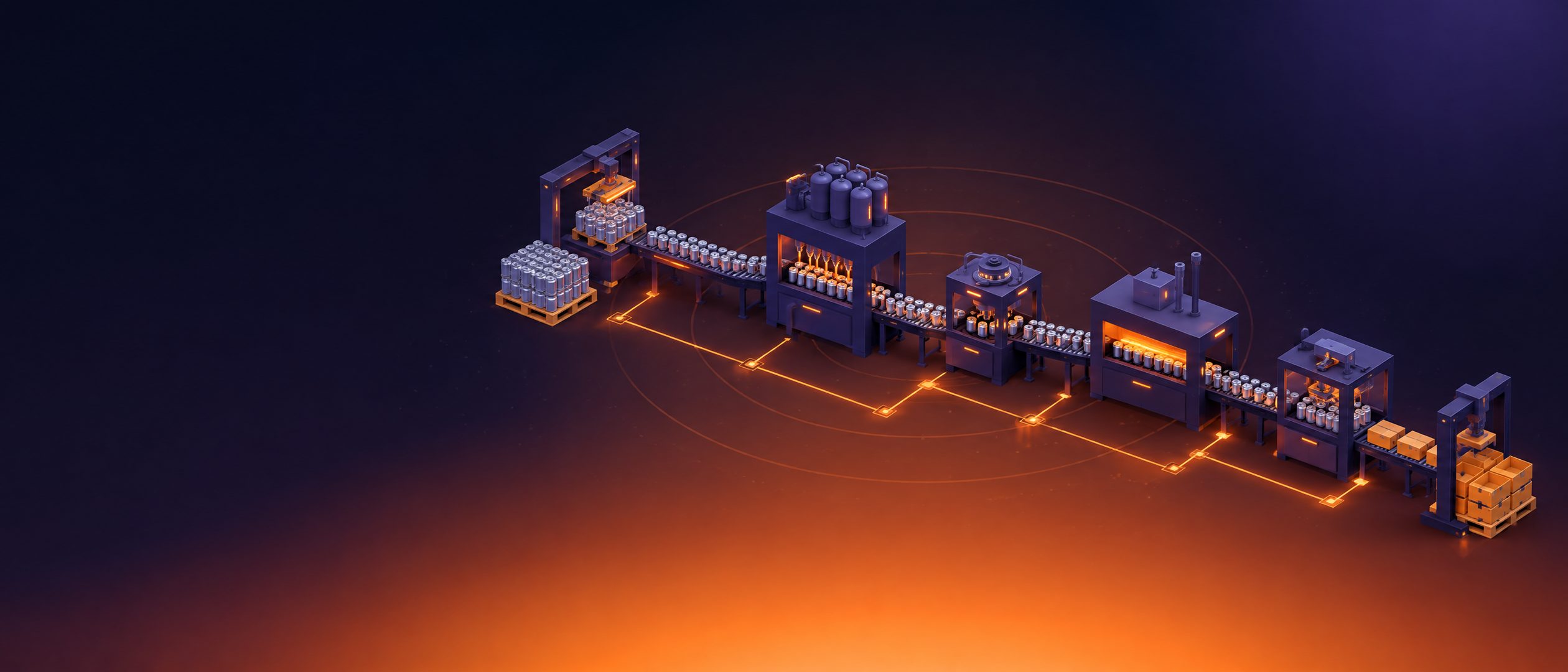
Cross Line Bottleneck Synchronization and Real Time Throughput Balancing
A high speed beverage bottling and packaging plant running 6 canning lines producing 1,500 cans per minute per line across depalletizing, filling, seaming, pasteurization, and case packing.
Read the use caseBring us the version of this that you actually have.
Every engagement is fixed in scope and milestone-gated. The scoping conversation starts with your systems, not with a template.