
Serialization Compliance for Regulated Medical Device Production
A medical device manufacturer must maintain unit-level serialization and device history records across three production lines to satisfy regulatory requirements.
Run on Anvaya · Production Execution & Traceability

Device history records are assembled from line paperwork and ERP transactions after the fact.
Serial Capture at Source → Automatic History Assembly → Completeness Checking → Instant Retrieval
Device history assembled during production instead of reconstructed afterwards.
The challenge
Device history records are assembled from line paperwork and ERP transactions after the fact.
Missing or inconsistent records surface during inspection, when correction is no longer possible.
Reconstructing the history of a single unit takes hours of manual searching across systems.
How our team solved it, with Anvaya
- 01
Serial Capture at Source
Anvaya captures each unit's serial at the point of build rather than reconciling it afterwards.
- 02
Automatic History Assembly
Process steps, operators, equipment, and material lots are attached to the serial as production happens.
- 03
Completeness Checking
Records missing a required element are flagged on the line, while the unit is still in the plant.
- 04
Instant Retrieval
Any unit's full device history is retrievable as a single record rather than reconstructed.
- 05
Inspection Readiness
Records are held in an inspection-ready state continuously rather than prepared for an audit.
- 06
QA Record Approval
The quality assurance lead reviews each completed device history record and approves the unit for release.
The outcome
- Device history records are assembled from line paperwork and ERP transactions after the fact.
- Missing or inconsistent records surface during inspection, when correction is no longer possible.
- Reconstructing the history of a single unit takes hours of manual searching across systems.
- Device history assembled during production instead of reconstructed afterwards.
- Incomplete records caught on the line rather than at inspection.
- Unit history retrievable as one record rather than searched across systems.
Delivered for a client; the client name is withheld under NDA. References are available on request.
Capabilities used
Every accelerator is assembled from the same capability layer, so a workflow you adopt here shares its foundation with the rest of the portfolio.
Run on Anvaya
Watch Anvaya run, end to end, in a few minutes.
Every order traced from raw material to finished unit, in one genealogy view.
See the Anvaya acceleratorMore from Anvaya

Shop-Floor Bottleneck Prevention and WIP Queue Control
A high-mix, medium-volume industrial equipment manufacturer produces heavy hydraulic manifolds and valve block assemblies for mining and earthmoving machinery. Their plant operates across six discrete production stages: CNC machining, deburring, ultrasonic cleaning, valve spool fitting, high-pressure hydraulic testing, and final painting. The plant handles dozens of concurrent customer orders with strict delivery windows and contract penalties for late delivery.
Read the use case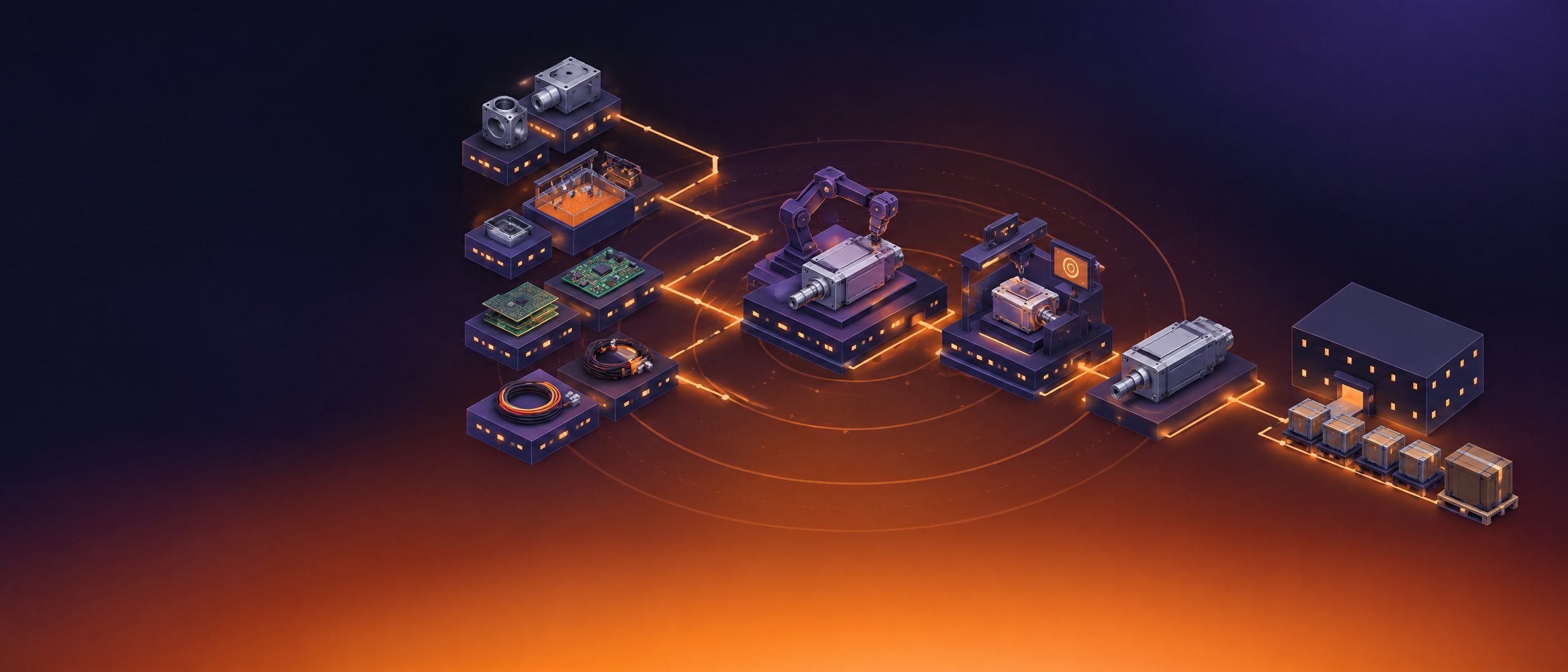
Multi-Tier Product Genealogy for Aerospace Subsystems
A Tier-1 aerospace supplier manufactures electromechanical flight-control actuators, integrating precision machining, surface treatment, multi-layer printed circuit board assemblies (PCBAs), and structural wire harnesses. Each completed actuator must comply with AS9100 safety and quality standards, requiring 100% verifiable component provenance across all assembly levels.
Read the use case
Instant Recall and Targeted Population-at-Risk Isolation for Medical Devices
An ISO 13485-certified medical device manufacturer produces portable patient monitoring units containing sensitive microprocessor boards and rechargeable lithium power modules. Production involves high-volume SMT PCBA assembly followed by multi-stage device integration and burn-in testing.
Read the use caseBring us the version of this that you actually have.
Every engagement is fixed in scope and milestone-gated. The scoping conversation starts with your systems, not with a template.